Holy Saturday


Holy Week Begins! Holy Week gives us the opportunity to re-live the passion of Jesus. We can never understand how much He loves us, but we are called to understand and think about the suffering He endured for us here on Earth. Happy Palm Sunday!
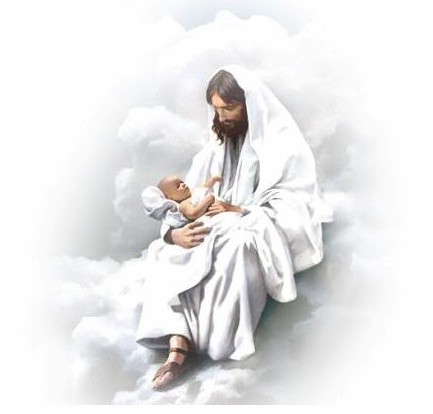
My Lord, the baby is dead!
Why, my Lord—dare I ask why? It will not hear the whisper of the wind or see the beauty of its parents’ face—it will not see the beauty of Your creation or the flame of a sunrise. Why, my Lord?
“Why, My child—do you ask ‘why’? Well, I will tell you why.
You see, the child lives. Instead of the wind he hears the sound of angels singing before My throne. Instead of the beauty that passes he sees everlasting Beauty—he sees My face. He was created and lived a short time so the image of his parents imprinted on his face may stand before Me as their personal intercessor. He knows secrets of heaven unknown to men on earth. He laughs with a special joy that only the innocent possess. My ways are not the ways of man. I create for My Kingdom and each creature fills a place in that Kingdom that could not be filled by another. He was created for My joy and his parents’ merits. He has never seen pain or sin. He has never felt hunger or pain. I breathed a soul into a seed, made it grow and called it forth.”
I am humbled before you, my Lord, for questioning Your wisdom, goodness, and love. I speak as a fool—forgive me. I acknowledge Your sovereign rights over life and death. I thank You for the life that began for so short a time to enjoy so long an Eternity. — Mother M. Angelica
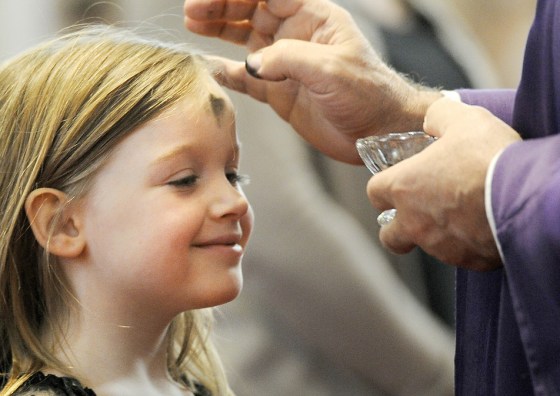
Ash Wednesday marks the first day of Lent, an important season in the Catholic Church of preparation for the resurrection of Jesus Christ on Easter Sunday. Ash Wednesday falls 46 days before Easter, which changes each year. This year, Ash Wednesday starts today, February 10!
Catholics are encouraged to attend Mass on this day to mark the beginning of the Lenten season.
The ashes used on Ash Wednesday are made by the burning of palms from the previous year’s Palm Sunday. They are administered on the forehead in the sign of a cross, and receiving them with humility is a sign of penance.
Ash Wednesday and Good Friday are obligatory days of fasting and abstinence for Catholics. In addition, Fridays during Lent are obligatory days of abstinence.
For members of the Latin Catholic Church, the norms on fasting are obligatory from age 18 until age 59.
Fasting on Ash Wednesday and Good Friday means we can have only one full, meatless meal. Some food can be taken at the other regular meal times if necessary, but combined they should be less than a full meal. Liquids are allowed at any time, but no solid food should be consumed between meals. The norms concerning abstinence from meat are binding upon members of the Latin Catholic Church from age 14 onwards.
Regarding what is classified as “meat” – here is what the United States Conference for Catholic Bishops site says:
Abstinence laws consider that meat comes only from animals such as chickens, cows, sheep or pigs — all of which live on land. Birds are also considered meat. Abstinence does not include meat juices and liquid foods made from meat. Thus, such foods as chicken broth, consomme, soups cooked or flavored with meat, meat gravies or sauces, as well as seasonings or condiments made from animal fat are technically not forbidden. However, moral theologians have traditionally taught that we should abstain from all animal-derived products (except foods such as gelatin, butter, cheese and eggs, which do not have any meat taste). Fish are a different category of animal. Salt and freshwater species of fish, amphibians, reptiles, (cold-blooded animals) and shellfish are permitted.
Beginning with Ash Wednesday and all through Lent, we are invited to live with a greater commitment to prayer, sacrifice and charity to prepare our souls for the holiest Feast of the year, Easter Sunday.
Wishing you all a beautiful Lenten season!

I remember when I first started re-discovering my love for the Catholic faith, I attended Mass at a beautiful church (Saint Brigid in Johns Creek, GA) that had the tabernacle and crucifix displayed prominently up front. The church I had been attending did not have this, so when I walked into this church, it moved me profoundly and brought me to tears.
I love the tabernacle not stuck in a corner. I love that Catholic churches have the altar front and center, and not a pulpit. I love to watch the priests and deacon kiss the altar when they enter and leave Mass. I love the bells, the candles, the incense, the statues of Mary, Joseph and the saints, the oils, the vestments, the stained glass windows . . . all of it. I love that during the consecration (in many churches) you hear these beautiful bells ringing, which call your attention to the miracle that is taking place upon the altar. These bells help to connect us in a deep and mysterious way to the Real Presence of Christ in the Eucharist.
I love the crucifix. You will come across some people who express distaste at the thought of depicting Jesus at His most vulnerable. Guess what? This should make you uncomfortable. Jesus does not want us to look at His Crucifixion as only a past event. Every lash that he took, every blow that drove the nail into his hands was caused by you and me. OUR sins (present, past and future) hung Jesus on that cross. The crucifix is the ultimate expression of the lengths that a loving God will go to reach us. Gazing at a crucifix is a humbling experience.
When we see incense being used in our churches, it is meant to remind us of heaven, and that our worship of God in the Christian liturgy is divine in origin. It also reminds us to pray, and that our prayer rises to God like the smoke from the censer, purifying our worship of God, and allowing his Holy Spirit to work in us to make us holy.
These little traditions and sacramentals all mean something, and make the Mass all the more meaningful and beautiful. They help us with all of our human failings and distractions to understand what is really going on at Mass, and to focus on Christ. Are they necessary for the validity of the sacrament? No. But can they help one to truly appreciate and recognize the beauty of the Holy Sacrifice of the Mass, and come to a deeper understanding of why we are there? Yes.
In an era where a tragically large number of Catholics no longer believe in the Real Presence of Jesus Christ in the Eucharist, or even attend Mass every Sunday, these sacramentals can help one focus on the miracle that takes place upon the altar. I love all of our beautiful traditions which are a very powerful devotional aid during Mass, and a rich sacramental tradition of the Church.
In the name of our Lord Jesus Christ I will begin this day.
I thank you, Lord, for having preserved me during the night. I will do my best to make all I do today pleasing to You and in accordance with Your will. My dear mother Mary, watch over me this day. My Guardian Angel, take care of me. St. Joseph and all you saints of God, pray for me.
O Jesus, through the Immaculate Heart of Mary, I offer You my prayers, works, joys and sufferings of this day for all the intentions of Your Sacred Heart, in union with the Holy Sacrifice of the Mass throughout the world, in reparation for my sins, for the intentions of all my relatives and friends, and in particular for the intentions of the Holy Father.
I wish to gain all the indulgences attached to the prayers I shall say and the good works I shall perform this day. Amen.


St. Michael the Archangel,
defend us in battle.
Be our defense against the wickedness and snares of the Devil.
May God rebuke him, we humbly pray,
and do thou,
O Prince of the heavenly hosts,
by the power of God,
thrust into hell Satan,
and all the evil spirits,
who prowl about the world
seeking the ruin of souls. Amen.

“And I saw a river over which every soul must pass to reach the Kingdom of Heaven, and the name of that river was suffering … and then I saw a boat which carried souls across the river, and the name of that boat was Love” ❤ Saint John of the Cross

Do Catholics worship Mary?
No, but like Jesus we love, honor and venerate His blessed mother. The Catholic Church has never worshiped Mary, and never will. Catholics worship God and God alone.
Heaven is not a “dead” place. Catholics believe people in heaven are very much alive. (Mat 19:29, 25:46, 10:17-22, Mk 10:30, Lk 10:25-30, Lk 18:18-30, Jn 3:15-16). We think Mary is totally alive, and is praying for us the way a faithful pastor would pray for his congregation, except much more so. She’s interceding for the unborn, for mothers contemplating abortion, and for many others who are experiencing sorrows in our world, and who want to grow closer to Jesus.
Why do we as Catholics honor, love and venerate her so deeply? We love Mary first of all because Jesus did. As Saint Maximilian Kolbe said, “Never be afraid of loving the Blessed Virgin too much. You can never love her more than Jesus did.” What better way to imitate Jesus than to love His mother?
Catholics do not put Mary on par with God. Mary is certainly worthy of reverence, but not worship. Catholics believe that Mary is the highest of God’s creatures because of her exalted role. Yes – Mary, a woman, is considered by Catholics to be one of God’s greatest creations. The Holy Trinity chose Mary, from all eternity, to be the mother of Jesus.
But of course, like any other human being, Mary had to be saved by the mercy of God. She herself said, “My spirit rejoices in God my Savior” (Lk 1:47). We believe that God saved her by taking away all stain of original sin at the moment of her conception (the Immaculate Conception). The very fact that God took on flesh and became man (Jn 1:1, 14) indicates that He wished to involve human beings in His plan of salvation for mankind. Mary was a key person for this purpose, so this is why Catholics honor her so highly.
The Hail Mary is not a prayer of worship, but it is a recitation of Scripture and then an asking of her to pray for us to God; much like asking our other Christian brothers and sisters to pray for us. The rosary (Saint John Paul II’s favorite prayer), is a Christ-centered prayer. It is like holding the hand of Our Blessed Mother and walking through the gospels and she leads us gently to her Son.
The Gospel of Luke 1:48 says, “Behold, from now on will all ages call me blessed.” Any time the Bible uses the word “behold” it means pay attention because what is about to be said is very important. In Luke 1:42 Elizabeth calls Mary “Most blessed among women” Mary is ‘most blessed among women’ and ‘highly favored’ by God. Elizabeth also refers to Mary as the “Mother of my Lord.” How many other people in Scripture have received such designations? None.
Mary knew she was called by God to be the Mother of Jesus. If Jesus chose to be born into this world through Mary how much more do you and I, “all generations”, need her to help us draw closer to Christ in our daily lives. What human on earth knew Jesus best? His mother. Mary’s sole purpose is to bring us closer to her son. You honor Jesus more by loving His mother.
We also love Mary so much because she was given to us as a gift. When Jesus was dying on the Cross He chose to give His mother to us. He could have given us any gift, but the Gospel of John tells us He gave us the gift of a Mom:
“Standing by the cross of Jesus were his mother and his mother’s sister, Mary the wife of Clopas, and Mary of Magdala. When Jesus saw his mother and the disciple there whom he loved, he said to his mother, Woman, behold, your son.” Then he said to the disciple, “Behold, your mother.” And from that hour the disciple took her into his home.”
Think about it, if Mary had any other children, it would have been scandalous in Jewish culture for Jesus to entrust Mary to a friend. Jewish tradition was for a child to care for a widowed mother, not a friend. From the cross when Jesus uttered, “Behold your mother” (Jn. 19:27), she became not only the mother of John, but of all whom Christ redeemed through the crucifixion. She is the mother of the Church – the mystical body of Jesus.
Since Mary is Jesus’ mother, it must be concluded that she is also the Mother of God. (Jesus is God.) Although Mary is the Mother of God, she is not His mother in the sense that she is older than God or the source of her Son’s divinity, for she is neither. Rather, we say that she is the Mother of God in the sense that she carried in her womb a divine person—Jesus Christ, God “in the flesh” (2 John 7, cf. John 1:14)—and in the sense that she contributed the genetic matter to the human form God took in Jesus Christ.
Catholics believe Mary’s soul still “magnifies the Lord” for Christians of our generation who choose to relate to her. Currently, Catholics continue to honor, love and call her blessed, which was intended for all generations, and for all Christians.
Our dear Blessed Mother, pray for us!
 Love Being Catholic